Muscarelle Museum’s ‘America’s Tapestry’ exhibition highlights the ‘struggle for independence’ among lesser-known American Revolution heroes
WILLIAMSBURG – In commemoration of America’s 250th anniversary, the Muscarelle Museum of Art at William & Mary has debuted the art exhibition “America’s Tapestry,” curated by textile scholar and designer Stefan Romero.
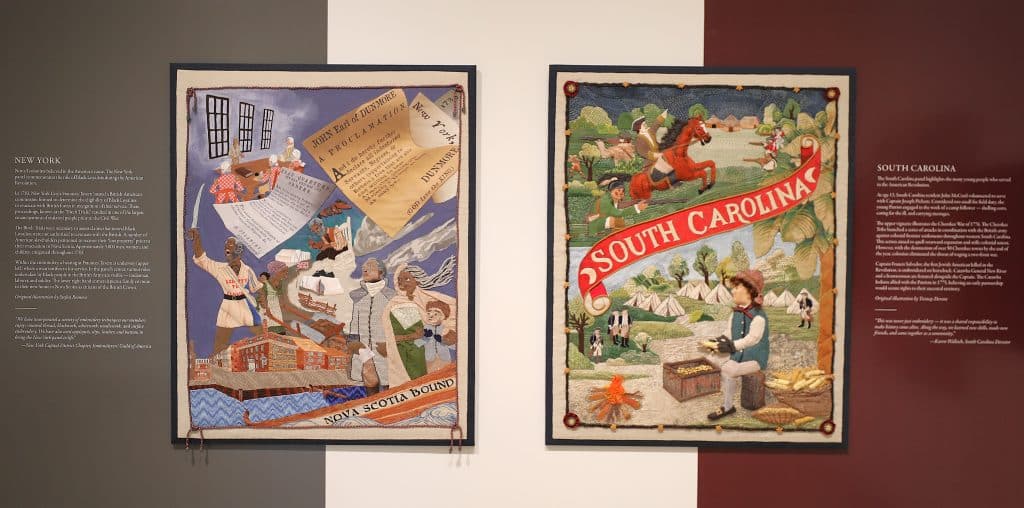
On view through September 6, 2026, 13 hand-embroidered panels, one for each of the original colonies, tell the stories of each state’s Revolutionary-era histories.
Taking inspiration from The Great Tapestry of Scotland, a community art project depicting 12,000 years of Scottish history over 160 hand-stitched panels, “America’s Tapestry” connects with visitors by inviting them to engage more deeply with defining moments in U.S. history.
Communally stitched by artisans from Georgia to New Hampshire, the intricate panels weave together the diverse stories of many individual contributions that reveal each colony’s struggle for independence.
“It’s special to see people come together across so many regions to tell these stories with their hands,” Romero said. “From the novice to the experienced artisan, over two years I’ve watched people collaborate to do work that would typically take triple or quadruple the time to achieve.”
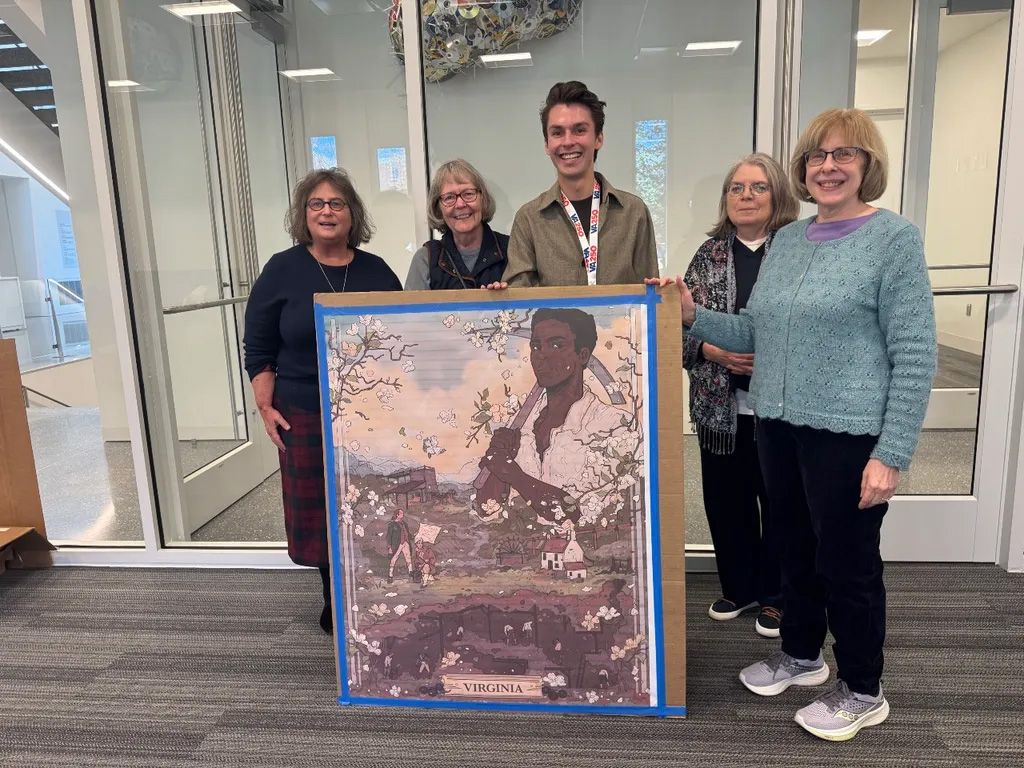
The Virginia tapestry was created onsite at the Muscarelle by members of the Williamsburg Rose and Thistle Chapter of the Embroidery Guild of America, along with community volunteers, under the direction of Catherine Theron.
The exhibition illustrates the story of Aberdeen, an enslaved man working in the lead mines in Wythe County that provided musket balls for the Continental Army.
Composed of enslaved, convicted and imported labor, the mining community was a melting pot of people who were forced to work in dangerous, dark conditions. Aberdeen defied his Loyalist enslavers’ orders to join the British cause and instead enlisted with the Continental Army, who later granted him freedom.
This once-in-a-generation fiber arts project also highlights the craftsmanship of thousands of volunteers, each representing their own state’s overlooked history.
“The 250th anniversary of the United States is a wonderful opportunity to dig deeper into specific experiences of the American Revolution,” said David Brashear, the Muscarelle’s director. “Many people remember learning about the larger narratives of our history. But what makes ‘America’s Tapestry’ exceptional is the way it reveals individual stories in a way that makes the struggle for independence feel more immediate and universal.”
The Georgia tapestry honors the Chasseurs Volontaires de Saint-Domingue, a militia unit composed of formerly enslaved and free soldiers from Saint-Domingue (present day Haiti). The New York panel pays tribute to Black Loyalists, whose service to the British Crown made them eligible to evacuate to Nova Scotia upon the war’s end.
North Carolina’s panel highlights the Edenton Tea Party, one of the first documented acts of political resistance by women in North America.
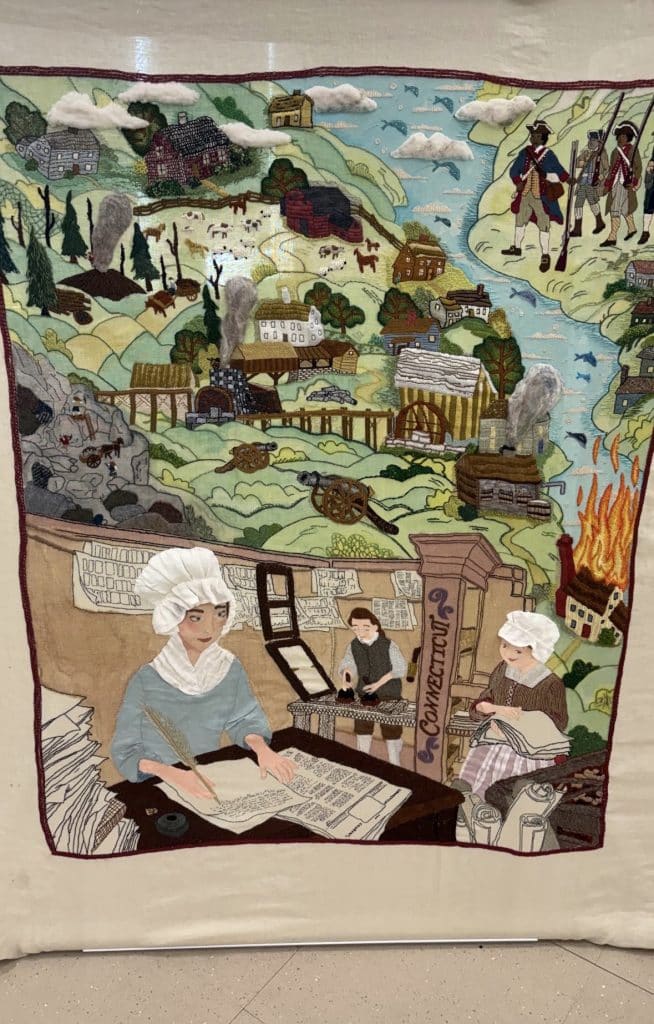
Other panels tell the stories of lesser-known heroes in the fight for independence: Henry Fisher, whose naval ingenuity protected the Delaware Bay from British incursion; Connecticut’s Hannah Bunce Watson, the first female editor of the Hartford Courant, who kept Patriot morale alive through her writing; and Pennsylvania’s Rebecca Young, one of the first documented makers of an American flag.
After debuting at the Muscarelle, “America’s Tapestry” will commence a two-year traveling tour to all participating states, beginning with Pennsylvania, New Jersey and New Hampshire. Virtual and in-person programming will also offer visitors opportunities to learn about the American Revolution and engage in the historic practice of needlework.
“The communities creating the tapestries are contributing to our country’s history, in addition to telling these founding stories,” Romero said.
The Muscarelle Museum is open Tuesday through Saturday from 10 a.m. to 5 p.m. and Sundays from 12 to 5 p.m. General admission is free, and the America’s Tapestry exhibition is included with admission.
For more information, visit muscarelle.wm.edu.
Thanks for reading! Will you help make our journalism possible?
The Triangle is a uniquely independent news source for Virginia's Historic Triangle and the surrounding region. We need our community's support to keep producing quality local journalism.