Election Day guide: What Historic Triangle voters need to know Tuesday
HISTORIC TRIANGLE – Election Day is here, and Virginians will help decide the national balance of power. This year, Historic Triangle voters are voting on:
- A U.S. Senator race between Democratic incumbent Mark Warner and Republican Bert Mizusawa
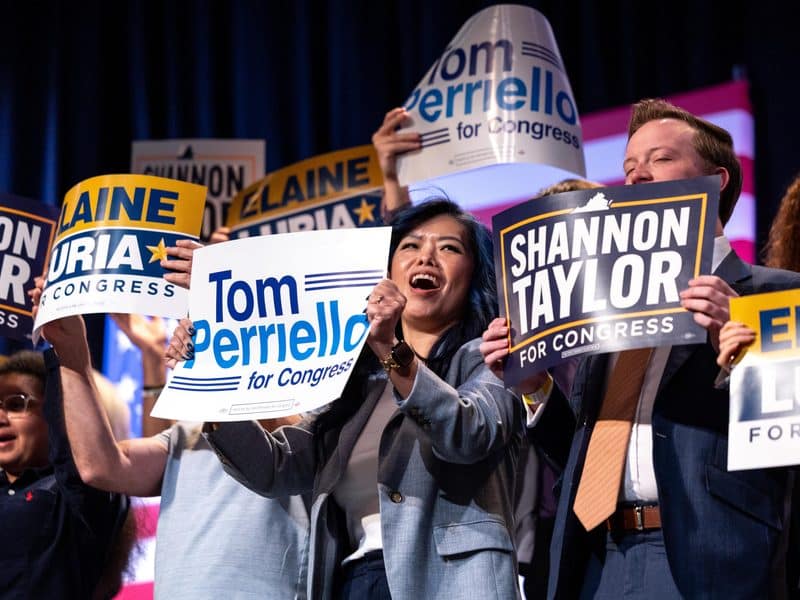
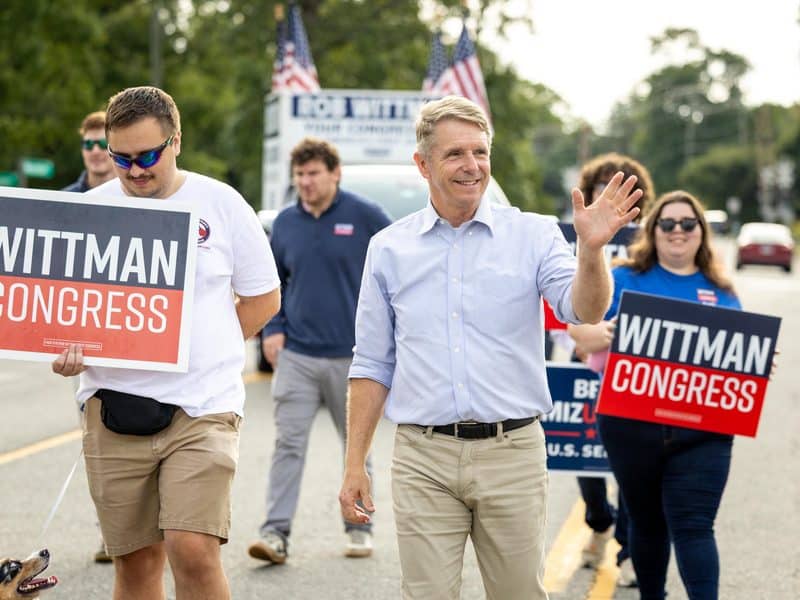
- A U.S House of Representative race in the 1st District between Republican incumbent Rob Wittman and Democrat Shannon Taylor
- A city council race in Williamsburg between incumbent Stacy Kern-Scheerer and newcomer
- Three proposed amendments to the state constitution focusing on the restoration of civil rights for felons, abortion and reproductive rights and same-sex marriage
- A proposed school sales tax for voters in York County
U.S. Senate
Mark Warner (D) – Incumbent
Brief bio: Democrat Mark Warner has been representing Virginia in the U.S Senate since 2009. He ran unopposed in his party’s primary this year. Warner graduated from Harvard Law School with a J.D. in 1980 and went on to serve as a staffer for Sen. Chris Dodd. He was also appointed as the Virginia Democratic Party chair. After launching two unsuccessful small businesses, Warner co-founded the cell phone company that became Nextel. He was Virginia’s governor from 2002 to 2006.
Top priorities: Warner told Cardinal News he believes the biggest challenge facing Virginia is the rising cos of living. “From groceries, to housing, to the utility bill, costs are climbing and Virginians are feeling the squeeze in their pockets,” Warner said. He introduced legislation “to require full refunds” of Trump’s tariffs in an effort to combat the effects of rising costs. Warner also says he is committed to making sure “developers, not residents, pay for costs associated with data centers.”
Website: markwarnerva.com
Burt Mizusawa (R)
Brief bio: Wittman said in an interview that his life began with “an act or extraordinary generosity” after his birth mother made the difficult decision to place him for adoption. He spent the first few months of his life at the Children’s Home Society of Virginia in Richmond and was adopted at eight months old to a father who was a World War II Army veteran and a mother who was a public school teacher. Wittman received a Ph.D. in Public Policy and Administration from Virginia Commonwealth University, He went on to work in state government for 26 years before being elected to Montross Town Council in 1986 and then serving as mayor. He was elected to the U.S. House of Representatives in 2007 and has represented the 1st District since that time.
Top priorities: Wittman told WAVY News he will prioritize “lowering costs for families, strengthening our economy and local businesses, supporting veterans and military families, protecting the Chesapeake Bay and our natural resources, supporting law enforcement, and keeping our communities and our country safe.”
Website: robwittman.com
U.S. Congress
Rob Wittman (R) – Incumbent
Brief bio: Wittman said in an interview that his life began with “an act or extraordinary generosity” after his birth mother made the difficult decision to place him for adoption. He spent the first few months of his life at the Children’s Home Society of Virginia in Richmond and was adopted at eight months old to a father who was a World War II Army veteran and a mother who was a public school teacher. Wittman received a Ph.D. in Public Policy and Administration from Virginia Commonwealth University, He went on to work in state government for 26 years before being elected to Montross Town Council in 1986 and then serving as mayor. He was elected to the U.S. House of Representatives in 2007 and has represented the 1st District since that time.
Top priorities: Wittman told WAVY News he will prioritize “lowering costs for families, strengthening our economy and local businesses, supporting veterans and military families, protecting the Chesapeake Bay and our natural resources, supporting law enforcement, and keeping our communities and our country safe.”
Website: robwittman.com
Shannon Taylor (D)
Brief bio: Taylor is a lifelong Virginian who has served as the Henrico County Commonwealth’s Attorney since 2011. On her website, Taylor states that she has “tried thousands of cases and put violent criminals, drug traffickers and abuser behind bars.” Taylor was re-elected as Henrico County’s top prosecutor three times.
Top priorities: Taylor has focused heavily on an anti-corruption platform throughout her campaign. She told the Cardinal News that if elected, she will prioritize ethics issues “In my first term, I will fight to end the corruption in Washington, just as I fought crime here in our district, by passing real ethics reform, like a ban on congressional stock trading, term limits, a lifetime ban on members of Congress lobbying the federal government,” Taylor said. She argues that the cost-of-living crisis is rooted in political corruption and “bad policies [that] protect the powerful.”
Website: shannontaylorva.com
Williamsburg City Council
Stacy Kern-Scheerer – Incumbent
Brief bio: Kern-Scheerer is the incumbent City Council representative in the race. A native of Louisville, KY, she earned a law degree from Boston University. Kern-Scheerer served as a nonpartisan legislative lawyer in the U.S. Senate for 10 years and has spent the past 13 years as a faculty member of William & Mary Law School. She has served on the boards of the Olde Towne Medical & Dental Center and Literacy for Life.
Top priorities: Kern-Scheerer told WAVY News the biggest issue facing the City of Williamsburg are related to finding a balance between keeping Williamsburg unique and charming and ensuring that it continues to thrive economically. “Addressing this challenge requires navigating and understanding all the issues that matter to residents, including housing, fiscal responsibility, transportation, land use, community preservation, and investment in public education and public safety,” Kern-Scheerer said.
Website: stacyforcitycouncil.com
Carolyn Murphy
Brief bio: Murphy worked in local government for 46 years and had a 30-year career in the City of Williamsburg’s Planning Department. On her website, she states that she has experience in real estate assessments, zoning, historic preservation and planning. Murphy led an effort to update the Comprehensive Plan with the Planning Commission and served on several local boards, including the WATA Board of Directors and the Hampton Roads Transportation Committee.
Top priorities: Murphy says on her website that she favors “a more conservative approach” to the budget, including borrowing, capital projects and expenditures. In an interview with The Virginia Gazette, she said she would prioritize balancing the city’s budget without dipping into reserves. She also believes it is necessary for the city to set aside money for future expenditures. “New CIP projects and programs need careful review, public buy-in and consideration before being placed in the budget,” Murphy said.
Website: carolynmurphyforcitycouncil.com
Eino Korpela
Brief bio: Korpela is a William & Mary graduate who launched a career in real estate and became a small business owner after graduation. He describes himself as a “young professional” who is “not a career politician” and chose to stay in Williamsburg after college because he fell in love with the city.
Top priorities: Korpela said Williamsburg’s greatest challenge is affordability. He told The Virginia Gazette he wants to “make our city more affordable by bringing in more outside funding instead of continually asking residents to pay more.” Korpela proposed a plan to help Williamsburg compete for more state and federal funding for “common-sense projects.” He also said he would work toward reforming the meals tax, which he believes has made it more expensive for residents to support local restaurants. Korpela supports requiring new developments to include affordable housing options for working families and young professionals.
Website: korpelaforcouncil.com
Constitutional Amendments
All Virginia voters will be faced with three amendment questions.
Question 1: Establishing the right to abortion
This proposed amendment defines reproductive freedom as a constitutional right in Virginia. It solidifies the right to make decisions about “all matters related to one’s pregnancy,” including prenatal care, childbirth, postpartum care, contraception, abortion, miscarriage management and fertility care.
The amendment stipulates that the Commonwealth maintains the right to “regulate the provision of abortion care in the third trimester,” except for in cases when abortion is deemed medically necessary to preserve the life of the mother.
Read the full text of Ballot Question 1 here.
Question 2: Removing a constitutional same-sex marriage provision
While the U.S. Supreme Court ruled to uphold the right to same-sex marriage in 2015, the Virginia constitution still includes language that bans same-sex marriage. If approved, this amendment would repeal that provision and ban the state from denying a marriage license to two adults based on sex, race or gender.
Read the full text of Ballot Question 2 here.
Question 3: Restoring felon voting rights
If passed, Amendment 3 would restore voting rights to convicted felons after they are released from incarceration. Virginia is one of only two U.S. states that permanently blocks felons from voting, except for people who receive an exemption from the governor. This amendment would overturn that policy, granting voting rights after a sentence is fully served.
Read the full text of Ballot Question 3 here.
York County Sales Tax Referendum
On July 1, 2026, a new law went into effect in Virginia allowing counties and cities to place a referendum on the ballot proposing a 1% tax that would be used to fund new school construction, major school renovations and associated financing costs. If approved, the tax would apply to the purchase of retail goods sold in York County. Groceries and essential hygiene products would be exempt.
Revenue earned through the tax could only be used for capital expenses and could not be spent on salaries, benefits, instructional materials, regular supplies or other school-related programming. The tax would remain in effect for 20 years or until the debt used to finance school construction and renovation is paid off.
York is one of over 40 Virginia localities including the referendum on its ballot this year. In the Hampton Roads region, the proposed sales tax is also appearing on the ballot in Newport News, Norfolk and Portsmouth.
The exact text of the referendum is as follows:
“Shall York County, Virginia be allowed to enact a local retail sales tax of up to one percent (1%) to provide funds that shall only be used for capital projects for the construction or renovation of public schools in York County, which tax shall expire on or before July 21, 2046?”
For additional information about the referendum, visit yorkcounty.gov.
Sample ballots
Click on the links below to view the sample ballot for each locality.
Sample ballots for any other locality can be viewed by using the address lookup tool on Ballotpedia.
Find your polling place
You can find your local polling place by looking up your address on the Virginia Department of Elections Polling Place Lookup page.
To vote, you will need to present a valid ID. A voter who does not have an acceptable ID or does not sign an ID Confirmation Statement will be offered a provisional ballot.
Voting hours
The polls in Virginia are open on Election Day, Nov. 3, 2026, from 6 a.m. to 7 p.m. As long as you are in line by 7 p.m., you can still vote.
What to expect on election night
About 3.4 million votes were cast in the last statewide election in Virginia in 2025. In that race, the AP first reported results at 7:10 p.m., or 10 minutes after the polls closed. The last vote update of the night came in at 1:52 a.m. ET, with more than 99% of total votes counted.
The AP does not make projections and only declares a winner when it is determined that there is no scenario that would allow a trailing candidate to close the gap.
In the event of a close race, Virginia does not conduct automatic recounts. A recount may be requested if the margin between a candidate and the apparent winner is 1 percentage point or less. When it comes to ballot questions, a recount may be requested if the margin of victory is 50 votes or fewer, or 1 percentage point or less.
Thanks for reading! Will you help make our journalism possible?
The Triangle is a uniquely independent news source for Virginia's Historic Triangle and the surrounding region. We need our community's support to keep producing quality local journalism.
Author