A massive Presidents’ Heads development is still under consideration in James City County. Here’s what to know

JAMES CITY COUNTY – A proposal seeking to develop a major attraction surrounding the giant presidential head sculptures in Upper James City County has been put on hold – for now.
The Board of Supervisors voted 3-2 last Tuesday to delay action on the request, but the project is still on the table.
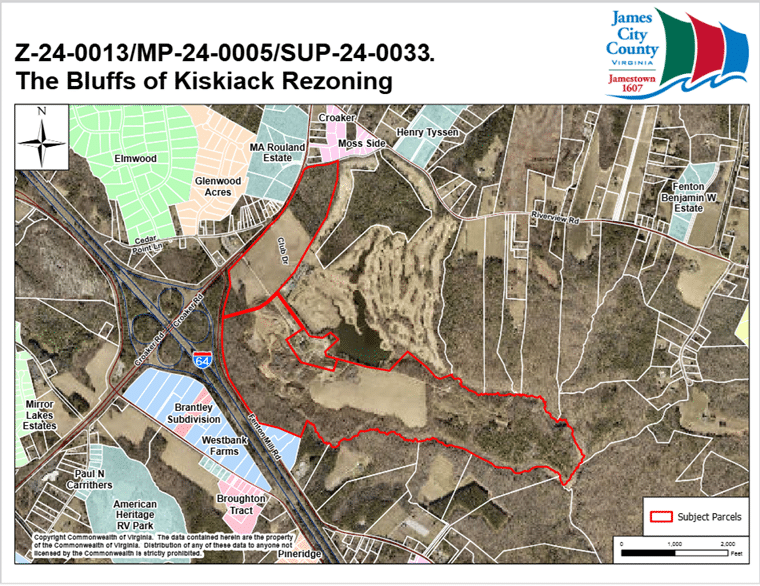
Applicant Vernon Geddy asked the board to delay its vote on a special use permit to rezone 276 acres of land for a massive mixed-use development off Croaker Road. The plan would transform the sprawling, rural land into a tourist mecca and residential neighborhood.
After multiple supervisors raised concerns about the project, Geddy said the developers needed more time to take the feedback into consideration and engage in discussions with neighbors.
Geddy’s request came after Vice Chair Ruth Larson stressed that the community has been largely left out of conversations about the proposal.
“We have been inundated with email from residents that live in the area,” Larson said. “These are communities that are used to rural character living. If I were the applicant, I would ask for time to meet with these residents.”
The proposal is set to be brought before the supervisors again in October.
The details
The large-scale project, called the Bluffs at Kiskiack, would place the infamous Presidents’ Heads at the center of a new destination.
The plan was created by developer Mark Jakobowski and landowner Howard Hankins.
Key features of the proposed development include:
- 704 housing units, half of which would be reserved for seniors. A total of 96 single-family homes and townhouses in the development would be designed to meet “affordable” housing criteria for residents who earn 80% of the Area Median Income (AMI).
- An amphitheater
- Retail shops, restaurants and a hotel
- A community gathering area
- Medical offices
- Recreation fields with a pavilion
- An independently operated local grocery store
- A clubhouse and pool for residents of the neighborhood
Background
The Presidents’ Heads – a collection of decaying, concrete and steel statues featuring the likeness of U.S presidents spanning from George Washington to George W. Bush – are currently located at a recycling facility on private property owned by Hankins.
Inspired by Mount Rushmore, the statues were created by Houston-based sculptor David Adickes. They were placed on display in a ten-acre outdoor museum in York County, which opened to the public as Presidents Park in 2004.
The site shuttered six years later after it failed to become financially sustainable. Hankins was hired to destroy the Presidents’ Heads but could not bring himself to do it. Instead, he hauled them to his property and has been in possession of them ever since.
The statues gained new life several years ago after Hankins agreed to allow photographers John Plashal and Fred Schneider to offer guided tours of the site several times per year.
Hankins’ family has owned the land where the sculptures are located since the 1600s.
What residents are saying
Of the 10 residents who spoke during a public hearing on the development, only two were in favor of the project.
Most worried the project would permanently change the rural nature of the area, generate too much traffic and strain local resources.
Resident Linda Rice said her Toano neighbors intentionally moved to the area because they wanted to live in a rural community.
“A number of people who have lived here have fought very hard to maintain that rural character,” Rice said. “I seriously doubt any of the current residents up here – and maybe future residents – would really want something like this.”
Bonnie Winston, who lives across from the proposed development, said the project could create a traffic nightmare for locals.
“The impact assessment… estimates that the project will generate more than 13,500 new vehicle trips per day,” Winston said. “This proposal raises a lot of questions that in my mind, and I think in the minds of other people, have not been addressed.”
On the other hand, Hunter Taylor, a local home builder and father of three children, expressed support for the proposal, saying the county desperately needs more affordable housing for families.
“We’ve limited growth in James City County far too long,” Taylor said. “We need an economy. We need housing. And we need smart development.”
What county leaders are saying
The supervisors were divided on the proposal, grappling over the benefits of the affordable housing component versus the potential problems the site could generate.
Supervisor Tracy Wainwright said the Bluffs would offer “assets and benefits” for the county, including the revitalization of the Presidents’ Heads attraction. The plan would provide about five acres of green space that could become a central gathering place for special events in the area, she said.
“The lake and music amphitheater would be privately owned… versus using tax dollars to do a music venue,” Wainwright pointed out. “There are a lot of really good aspects to this, but there are a lot of challenges.”
Wainwright stressed that the lack of local affordable housing is a serious problem, noting that her young adult children cannot afford to live on their own in the county. Nonetheless, the number of proposed homes in the development seemed excessive, she said.
“Density for me is going to be the problem,” Wainwright said.
Supervisor Barbara Null said she could probably support the project because “it offers everything,” including continuing care facilities for seniors and affordable housing that would appeal to military families.
“We have so many military people here,” Null said. “And they need help.”
Supervisor Jim Icenhour questioned whether the “affordable” housing units in the proposal would truly make a dent in the county’s growing cost-of-living crisis. The homes would be priced in the $281,000 range, meaning residents earning less than 80% of the AMI would likely be shut out, he said.
Icenhour also expressed concerns that the project’s scale would strain the county’s wastewater infrastructure.
“Ultimately, I have to make a decision based on the best evidence I have for the benefit of the taxpayers that I represent,” Icenhour said. “I’m not sure that I can support this one.”
Larson said residents of the Norge area have been surprised to learn the details of the project and have mostly pushed back against it.
“They don’t want to see this,” she said.
Nonetheless, Larson emphasized that the county urgently needs more affordable housing.
“We have to have a place for the young people in this community to live,” Larson said. “We have to answer that, too, as a board.”
Board Chair John McGlennon echoed Icenhour’s concerns that the development would not serve many of the county’s residents who are most in need of affordable housing. He also worried the site might fail to draw sufficient tourist interest.
“I’m really concerned that this project would not succeed,” McGlennon said. “In addition to the concerns raised by folks who feel this is going to fundamentally change the character of their communities, this is not, to my mind, financially sustainable.”
Icenhour and McGlennon voted against deferring the vote on the project, having stated that they could not support the rezoning request. Larson, Wainwright and Null voted in favor of delaying the vote.
Up next
The developers will bring the proposal forth to the Board of Supervisors for a vote on Oct. 13.
Thanks for reading! Will you help make our journalism possible?
The Triangle is a uniquely independent news source for Virginia's Historic Triangle and the surrounding region. We need our community's support to keep producing quality local journalism.
Author