A living legacy: William & Mary receives global arboretum designation
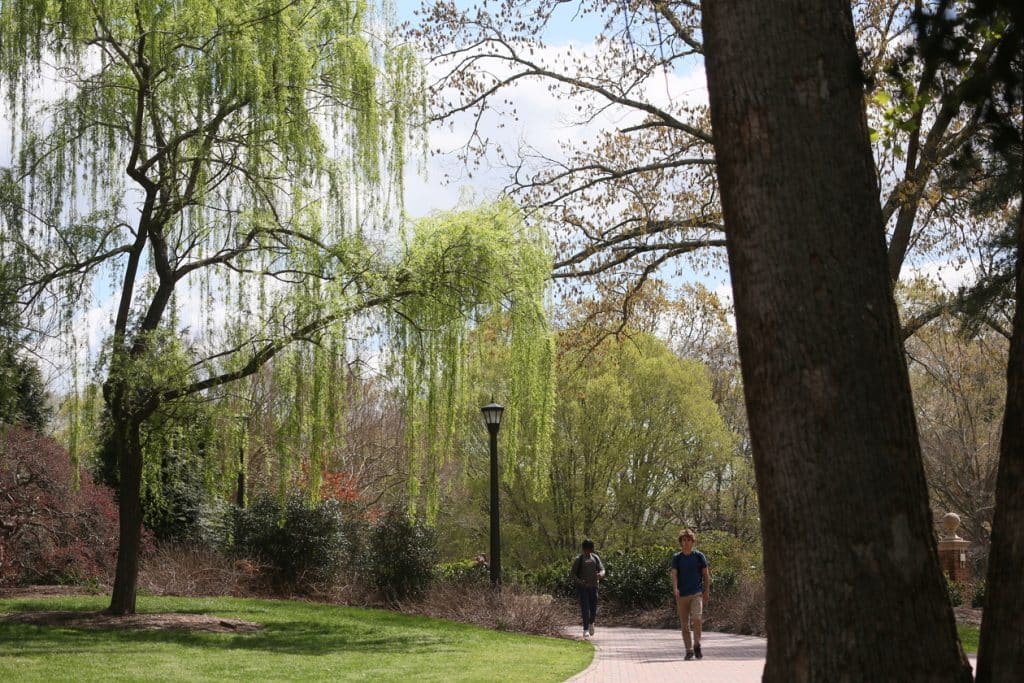
WILLIAMSBURG – The College of William & Mary’s campus recently received arboretum accreditation, making it a “living museum” of trees and woody plants. The designation shines a light on the dedicated efforts of those at the College who have cultivated the site.
To be officially considered an arboretum, an organization must have a labeled botanical collection of diverse types of plants. They must also actively maintain the collection and have initiatives that respond to societal needs, such as tree conservation, science and public programming.
The honor comes from ArbNet, a global network of arboreta and tree-focused professionals. The network runs the only international accreditation program specifically for arboreta, where they use an area’s collections, capacity and conservation efforts to determine the level of accreditation.
“The campus arboretum is a living and teaching asset stewarded by dedicated faculty and staff, documented through an arboretum plan and open to the public for education and enjoyment,” said Chief Business Officer Sean Hughes. “It is a crown jewel for the university.”
Faculty at the university have built up the framework for this achievement for decades now, starting with botanists in the mid-20th century planting imported seeds across the campus.
Since these seeds originated from all over the world, there are many unusual plants on the campus, some of which are heirloom cultivars. Over the years, professors have continued the work of documenting and planting these species.
Associate Professor of Biology and Conservator of Botanical Collections Martha A. Case has been working with the College’s botanical collections for over 30 years, and strives to promote, preserve and develop plant collections for teaching, research and outreach. Case explains that there are many facets to the accreditation.

“Accreditation is not simply validation that a nice collection exists. It requires leadership, professional curation, plant care programs, conservation initiatives and programs that advance scientific discovery and public outreach,” Case said.
Upon receiving the designation, William & Mary has become one of only 953 globally accredited arboreta in over 40 countries. A total of 20 of these are in Virginia, and several are nearby, including Colonial Williamsburg and Ford’s Colony.
William & Mary holds accreditation at level one, which requires the institution to meet standards for public access, planning, identifying, labeling and collecting trees. The College currently identifies about 100 known species in an ongoing effort to classify approximately 3,000 woody plants across 250 acres of campus grounds. Further labeling, planting and collecting is required to advance to the next level.
According to Chad Peevy, urban forester for grounds & gardens, there are nearly 77,000 individual trees on campus, some of which are rarely found in Virginia.
Some noteworthy species include a white mulberry (Morus alba) that may be over 200 years old, Japanese cedars (Cryptomeria japonica) and coastal redwoods (Sequoia sempervirens). One standout is the dawn redwood (Metasequoia glyptostroboides), which was planted from seed by Professor John T. Baldwin Jr., and now stands at 113 feet tall. This tree is considered a “living fossil” as the species was thought to be extinct until 1946.
Exploring these green spaces often serves as a pastime for the public. To facilitate this, the College launched the William & Mary Arboretum Explorer, an interactive online platform that provides visitors with the information and resources needed to take a tour of the plants and trees.
“This link takes you into our arboretum system, where you can search for plants in our collections, read about them online or come to campus and find them with your phone,” Case said.
While the new platform is useful for visitors and tourists, it is also an important tool for those involved in preserving these trees. As time goes on, the flora of the campus changes, and this new technology is used to record shifts and updates.
Case noted that the program includes a tour, “Tree-mendous Trek,” which helps the public locate the trees that are labeled in the arboretum.
“Finding a labeled tree is a bit of a needle in a haystack unless you go to the tour system and click on Tree-mendous Trek,” Case said.
William & Mary’s newly recognized arboretum, in combination with the others in the area, are living evidence of the dedicated individuals working to preserve and maintain green spaces.
The expert gardeners who maintain William & Mary’s arboretum now have access to collaborations with the other arboreta around the world, allowing them to share research and data. That cooperative process offers opportunities to further the protection of endangered species, like the majestic dawn redwood.
“Conservation is not just about species on the brink, but about entire ecosystems made up of hundreds of interacting species that sustain the health of our planet,” Case said. “We need to think holistically, rather than focus our attention on rare plants only. Unfortunately, entire ecosystems are now under threat from global change,” Case said.
Beyond its visual appeal, the land at William & Mary’s campus is intended to be an academic asset and resource that serves the community, and now the international community of arborists.
“Our gardens and landscapes connect us to ecological systems in ways we often overlook. For example, you might be planning to add pollinator plants, not realizing that the red maple you planted years ago is a critical early-season food source for solitary bees,” Case said. “These are the kinds of connections a university arboretum can help people see—connections that inspire action and provide a sense of purpose in challenging times.”
The arboretum designation is significant to the College’s mission to “inspire lifelong learning, generate new knowledge, and expand understanding,” while also bringing attention to one of the beautiful living museums in Williamsburg that the public can access for free.
“It isn’t just labeling trees. It’s supporting teaching, research and conservation,” Case said. “It’s like a museum with a living collection.”
Thanks for reading! Will you help make our journalism possible?
The Triangle is a uniquely independent news source for Virginia's Historic Triangle and the surrounding region. We need our community's support to keep producing quality local journalism.