Williamsburg parents launch nonprofit to support families of teens with eating disorders

WILLIAMSBURG – On June 14, 2024, JB and Heather Williams received the kind of news that is every parent’s worst nightmare. Their 20-year-old daughter, Ashley, had died after being hit by a car.
Investigators say that Ashley, a rising junior at James Madison University, was struck while walking during a beach vacation with friends in Kill Devil Hills, N.C.
The tragedy was devastating to the friends and family of a bright young woman described as “full of light.”
While JB and Heather continue to face intense grief from the loss of their daughter, they have found a sense of purpose by launching a new nonprofit: Ashley’s Heart for Recovery.
The organization is designed to provide support and financial assistance to families of teens who are suffering from eating disorders.
It is a cause that is deeply personal to the Williams family. In 2021, Ashley had recovered from an eating disorder that was initially spurred amid the isolation of the Covid-19 pandemic.
“She was an athlete and a runner, and all of that stopped during Covid,” Heather said. “She put on some weight and decided she was just going to try to lose a few pounds.”
What began as a seemingly harmless diet soon spiraled into something dangerous.
“If there’s a predisposition for an eating disorder, along with an environmental factor, like restricting your diet, then it gets triggered,” Heather said. “And that’s what happened with Ashley.”
The prevalence of eating disorders rose by at least 15% during the Covid-19 pandemic, according to a study published in The Lancet. The National Alliance for Eating Disorders helpline has reported a 40% increase in calls for assistance since March 2020.
Experts say the recent rise in cases can be attributed to several factors, including the loss of socialization and the disruption in routines many experienced during the pandemic.
Social media also appears to be playing a significant role. Trends like “SkinnyTok,” a corner of TikTok that promotes extreme thinness, is further amplifying the prevalence of eating disorders across the globe, especially among young people.
“Research studies have found consistent links between social media use and body dissatisfaction, low self-esteem, disordered eating and anxiety,” said Dr. Samantha DeCaro, the director of clinical outreach and education at The Renfrew Center.
For Ashley, the road to recovery involved seven weeks at a residential treatment facility in Northern Virginia, followed by a four-week intensive outpatient program. Upon returning home to Williamsburg, she completed an additional six-week program.
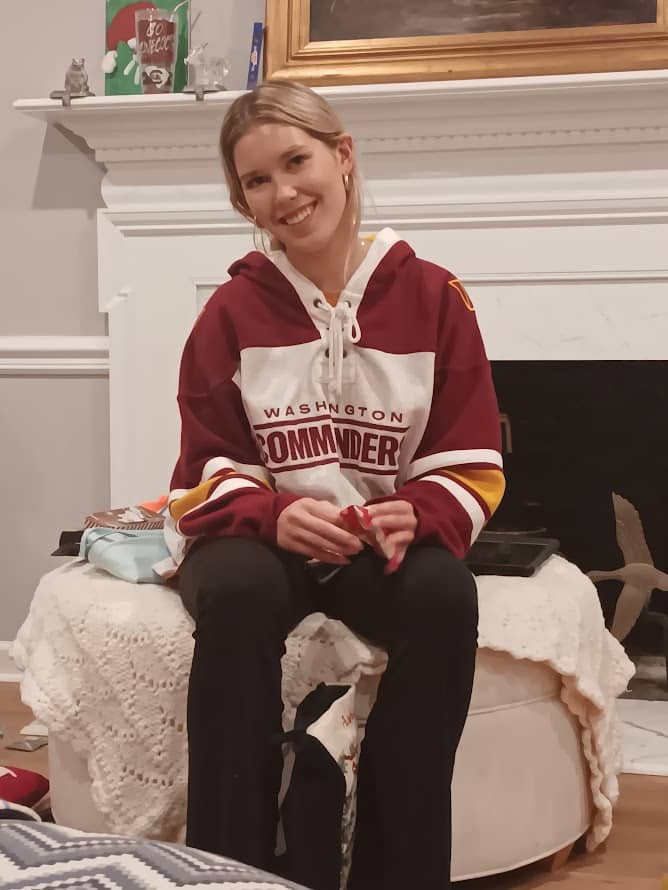
Ashley then received ongoing support from an outpatient team of therapists and dieticians who specialize in eating disorder management.
“She continued with that treatment team up until her passing,” Heather said. “She was motivated to stay in recovery while she was at college, and she was very open about trying to dispel myths about eating disorders.”
Surrounded by the support of her family, Ashley thrived following treatment. But the road to recovery is challenging for many families, particularly because of the expense involved.
The residential facility Ashley attended had a six-to-eight-week waitlist, but acceptance into the program was only part of the battle. The cost of the treatment was about $2,000 per day, and getting adequate insurance coverage was a challenge, Heather recalls.
While eating disorders are associated with serious long-term health effects, less than 20% of afflicted teens receive appropriate treatment, according to the Children’s Hospital of Philadelphia PolicyLab.
The treatment gap is largely attributed to a lack of public awareness surrounding eating disorders, as well as cost barriers, including insufficient insurance coverage for evidence-based treatment. In some cases, insurers cut off coverage before the patient fully recovers.
The expense involved is often so high that families cannot afford to visit their child during treatment.
Residential facilities that treat eating disorders in the U.S. are in short supply and are frequently overbooked. As a result, many teens are forced to travel far from home to begin their recovery.
“Some people spend their life savings to get their child treatment, and they don’t have money to come visit them or to stay in a hotel for a night or fly there,” Heather said.
That is the driving force behind Ashley’s Heart for Recovery.
“Our hope is that, through working with treatment facilities, we can identify families that are tapped out financially, and we can provide them money to visit their child in treatment,” Heather said.
To kick off their fundraising efforts and raise awareness about eating disorders, the Williams family is hosting their first-ever walk in honor of Ashley beginning at 2 p.m. on May 18 at Powhatan Shores Park in Williamsburg.
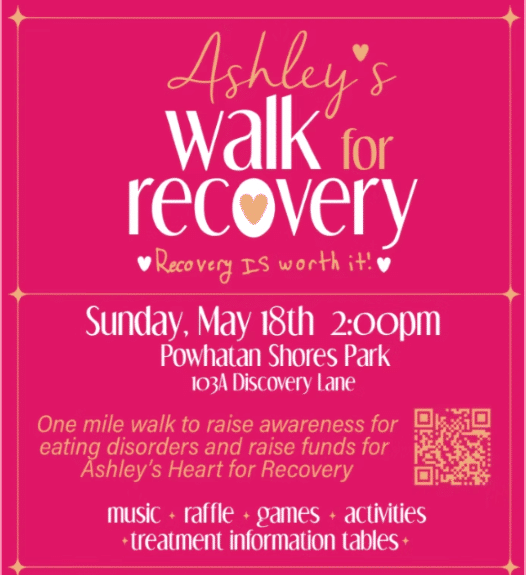
An informational table featuring resources about treatment options offered by local organizations will be on-site during the event.
Those who participate in the walk will be able to write an anonymous letter to someone who is in treatment to let them know that “someone cares and is thinking about them,” Heather said.
The event will also feature several motivational speakers, a photo booth, trained therapy dogs, a temporary tattoo station and a raffle.
Among the scheduled speakers are Megan Freeman, the founder of the Abundant Life Partners counseling center in Williamsburg, and Sarah Makl, a close friend of Ashley’s who today is thriving after recovering from an eating disorder.
Registration for the walk will be open until the day of the event; however, anyone who would like to receive a free event t-shirt must register by May 8.
Donations to support the organization can be made online or via Venmo at @AshleysHeartForRecovery.
Heather underscored that being as proactive as possible in seeking treatment is key when addressing eating disorders among teens and people of all ages.
“My advice is to get the most aggressive form of treatment you can as early as you can,” she said. “The longer those patterns of behavior continue, the more entrenched they become, and the harder they are to fight.”
A key goal of the nonprofit is to serve as a bridge that can connect the community to resources that assist with recovery from eating disorders.
Additionally, the organization will continue Ashley’s legacy of raising awareness about eating disorders and providing comfort to others during their most challenging moments.
“One thing we have heard repeatedly from Ashley’s friends is that she was the person they would go to if they were upset,” Heather said. “She was very inclusive and didn’t want anyone to feel left out. She always went out of her way to make them feel heard and loved.”
If you or someone you know is suffering from an eating disorder, contact the National Alliance for Eating Disorders helpline at 1 (866) 662-1235. The helpline is open Monday-Friday from 9 a.m. – 7 p.m. EST.
Thanks for reading! Will you help make our journalism possible?
The Triangle is a uniquely independent news source for Virginia's Historic Triangle and the surrounding region. We need our community's support to keep producing quality local journalism.
Author