Historic Triangle residents push back against proposed tax hikes at public budget hearings
HISTORIC TRIANGLE – Public hearings on proposed budgets in James City and York counties centered on a consistent theme: Historic Triangle residents are feeling over-taxed, and many are concerned about the rising cost of living in the area.
Here’s a rundown of what happened at the recent public budget hearings.
James City County
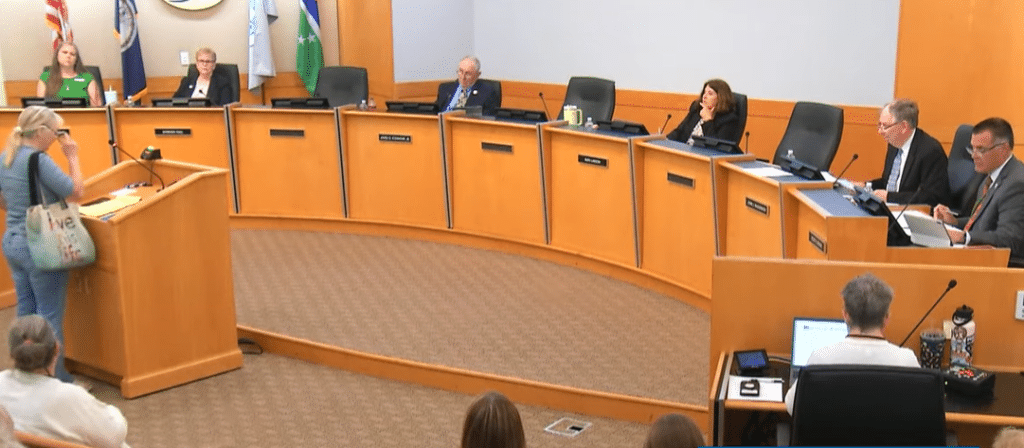
Residents poured into a James City County Board of Supervisors meeting last week to push back against another round of proposed tax hikes.
Dozens attended the April 14 budget hearing, with 17 speakers taking to the podium to oppose rising real estate taxes and a planned meals tax increase.
Why it matters
County Administrator Scott Stevens’ proposed budget for the upcoming fiscal year includes a 3-cent cut to the real estate tax rate, but property tax bills are still going up in the wake of higher reassessments.
James City County is on track to collect about $10 million in new revenue during the upcoming year compared to last year, according to Sharon McCarthy, financial and management services director. That figure factors in the 3-cent cut.
The county would have received an additional $5.5 million in revenue if the proposed cut had not been implemented, McCarthy noted.
Nonetheless, reassessments are up by an average of 10.31%. As a result, residents are still paying an average of 7.31% more on their property taxes.
That is on top of an 18.06% average increase in 2025, an 8.16% increase in 2023 and a 1.81% increase in 2021. Between 2015 and 2019, reassessment values had been relatively stable, changing by less than 1% each cycle.
What residents are saying
Some residents who spoke at the meeting said their reassessments rose much more than the average figure cited by the county. Many argued that the persistent tax hikes over the past several years are simply becoming too much.
Resident Virginia Mains said that when she moved to the county five-and-a-half years ago, she was grateful to plant roots in an area that was well-maintained and had a reasonable tax rate.
In recent years, however, Mains said she has become dismayed by the notably higher taxes and the reluctance of local leaders to rein in capital spending.
“I really feel you are not representing the constituents that you should be,” Mains said. “We come and say [the] tax rate is going too high. You are putting up things we don’t want. Pay attention to us. Listen to us.”
Mains’ concerns were echoed by other speakers, including Claude Gilmer, a longtime resident of the Grove community.
Gilmer said upon receiving the most recent reassessment notice, “the top of my head nearly blew off.” He warned that the county is on track to begin experiencing an exodus because the cost of living is becoming unsustainable – and residents feel their voices are not being heard.
“[The] social security increase was 2.8% this past year, and you’re talking about 18.3% increase on the money that I have to pay you,” Gilmer said. “So, I just ask you: What are you doing? Why aren’t you listening?”
Ben Johnson, co-owner of the Express Laundry laundromat on Richmond Road, said his business literally runs on quarters. He told the supervisors his property tax assessment jumped by a staggering 68% this year.
“That’s a lot. That’s a lot of quarters,” Johnson said. “So, the question is, where are we going to get the quarters?”
Johnson added he will have no choice but to increase the cost of services, which will negatively impact the many lower-income and fixed-income customers he serves.
Meals tax opposition
Following in the steps of the City of Williamsburg, Stevens’ proposed budget includes an increase in the meals tax.
If approved, the levy on all prepared meals in the county would jump from 4% to 6%. Per Virginia code, a 6% meals tax is the highest rate any county can implement.
When combined with the state’s 6% sales tax and the 1% Historic Triangle sales tax, a combined 13% levy would apply to all prepared meals sold in the county.
As previously reported, Virginia localities notoriously have some of the nation’s highest meals tax rates, exceeding those seen even in major metro regions like New York City.
Rachel Sears, the executive director of the Williamsburg Area Restaurant Association (WARA), urged the supervisors not to move forward with the proposed meals tax hike.
Sears said Williamsburg “should be and is a dining destination,” but the increasingly high tax on meals is jeopardizing that status. She keeps a binder filled with emails and notes from customers who are “appalled” at the taxes they had to pay to dine out, she said.
“I think the term ‘don’t bite the hand that feeds you’ comes to mind,” Sears said.
What’s next: The Board of Supervisors will hold a business meeting featuring a budget discussion on April 28. While the public is invited to attend, there will be no opportunities for public comment.
A finalized budget for the upcoming fiscal year is expected to be adopted on May 12. The full proposed budget is available at jamescitycountyva.gov/budget.
York County
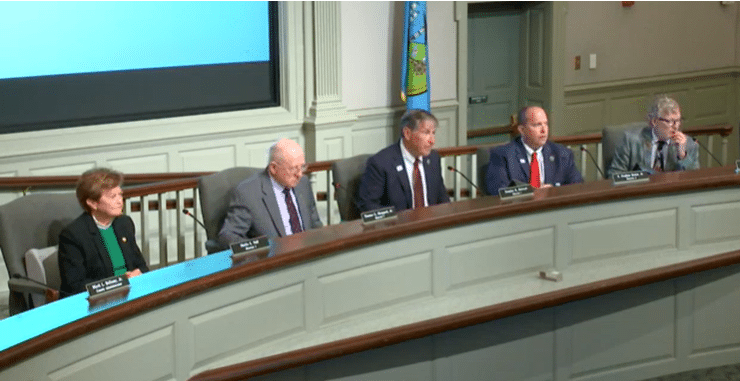
Rising costs and increased taxes were also front and center at York County’s public budget hearing on Tuesday.
While the county is proposing to hold the current real estate tax rate of 78 cents per $100 of valuation, homeowners have bemoaned the latest reassessment hikes and resulting higher tax bills.
What residents are saying
Resident Carla Mujeune asked the board to consider dropping the real estate tax rate to help offset the household economic impact of the higher reassessments.
Stephen Romeo criticized the total price tag of the proposed budget, saying inflation is not enough to justify such heightened spending.
“National inflation is about 3.3%. I think the best that you can do in good faith is to look at a 4% increase in the budget,” Romeo said.
Romeo also urged the supervisors to operate more transparently when it comes to spending. He asked officials to publish monthly reports on the taxpayer funds that are spent, along with a three-month projection of expenditures.
If the proposed budget is adopted, General Fund spending would rise to $214.7 compared to last year’s $200 million, an increase of 7.3%. That is in addition to an increase of 5.8%, or $11 million, the year before.
Mirroring James City County, York County is looking at a 2% meals tax hike, from 4% to 6%.
Resident Mark Williams spoke out against the potential meals tax increase, saying it would be especially harmful to low and moderate-income families.
Many working parents, he said, are time-strapped and often do not have the luxury of buying fresh food at the grocery store and preparing it at home.
“It is an indirect tax [on] the children who do not have the right to come and speak at this podium,” Williams said.
Response from county leaders
The supervisors ultimately did not seem interested in reducing the taxes in the budget, saying this year’s increases were as lean as they could be while still providing needed salary increases for county staff.
“The bulk of [the higher spending] is the compensation increase,” District 1 Supervisor Doug Holroyd said. “We felt it was necessary to retain our employees. I don’t think there’s a whole lot of debate on us proceeding with that.”
Stephen Roane, supervisor for District 4, said the revenue collected from the recent reassessments fell short by $4 to $5 million in covering the expenses in this year’s budget.
“Our cost pressures go above and beyond the rate of inflation,” Roane said. “I just don’t see an opportunity where we could lower the tax rates even with the increased assessments because increased assessments didn’t cover all the bills.”
What’s next: York County’s final budget for Fiscal Year 2027 is scheduled to be adopted on May 6. The full proposed budget is available for review at yorkcounty.gov/budget.
Thanks for reading! Will you help make our journalism possible?
The Triangle is a uniquely independent news source for Virginia's Historic Triangle and the surrounding region. We need our community's support to keep producing quality local journalism.
Author