Colonial Williamsburg Powder Magazine enters next phase of restoration ahead of VA250
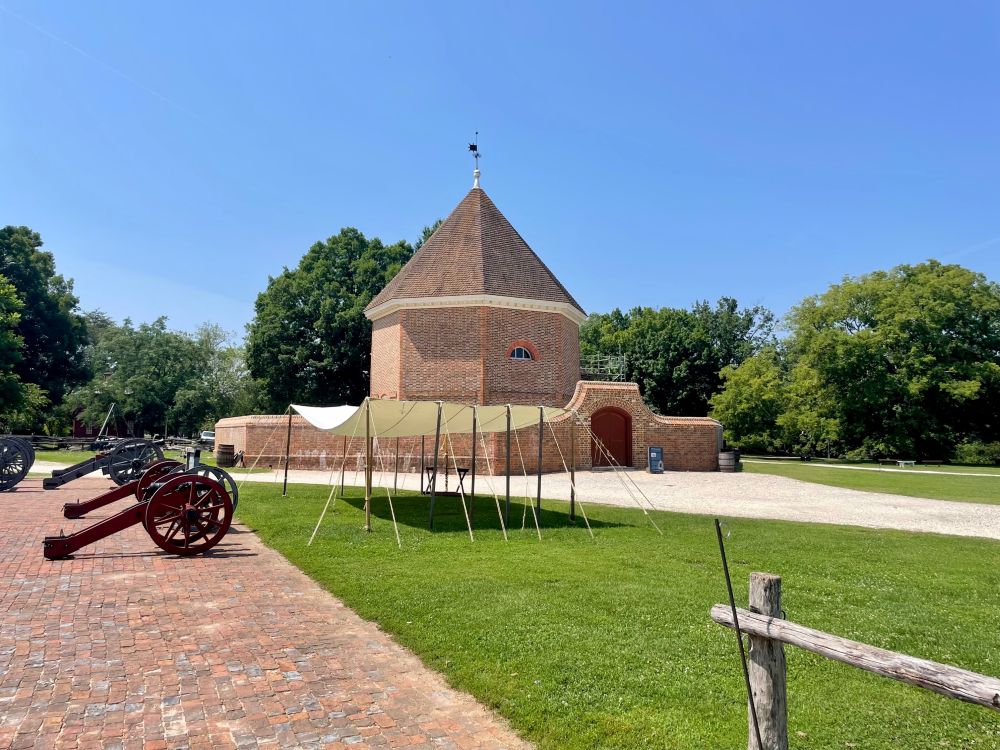
WILLIAMSBURG – The Colonial Williamsburg Powder Magazine is currently undergoing its first major restoration in nearly 100 years, led by researchers from the Colonial Williamsburg Grainger Department of Architectural Preservation and Research.
Originally built in 1715 to store gunpowder and other military supplies, the Magazine is now preserved as a symbol of the American Revolution for its role in the pivotal “Gunpowder incident.”
The multi-phase restoration began in 2021 and is on track to be completed by July 2026 – in time for the 250th anniversary of American Independence and the related commemorative events across the Historic Triangle.
A major milestone was reached this past April when the perimeter wall was lowered from ten feet to seven feet to reflect greater historical accuracy.
The next phase focuses on newly uncovered evidence that could drastically alter the building’s current appearance.
A few years ago, fragments of diamond pane window glass and lead came were found at the site, which suggests that the Magazine originally had casement windows and a lunette window at the front.
This spring, Grainger Department researchers Tessa Honeycutt and Jennifer Wilkoski traveled to England for two weeks to review historical documents at the National Archives in Kew and the National Library. They met with experts at several English historical powder magazine sites to gain insight into what could be relevant to the Colonial Williamsburg Magazine’s structure.
As part of their window research, Honeycutt and Wilkoski visited The Brooking Collection, which comprises the late architectural historian Charles Brooking’s vast collection of discarded architectural fragments.
“The Brooking Collection was a highlight of our trip… his knowledge was invaluable in helping us understand what casement windows would have looked like in this period,” Wilkoski told The Triangle.
Remaining renovation work on the Magazine includes restoring doors, finishing the interior and revisiting the items stored inside the building – such as firearms – to bring it as close as possible to its Revolutionary-era condition.
In his recent appearance on Cardinal News’ Cardinal250 podcast, Matthew Webster, Executive Director of the Grainger department, discussed the Magazine’s historical significance and transformation with host Dutchie Jessee.
“This building has had a tough life, and it has not been an easy building to restore. We are being very careful in everything that we are doing,” Webster said.
The Magazine was originally commissioned in 1712 by Lieutenant Governor Alexander Spotswood as a secure site to store military supplies for colonial defense during the French and Indian War. It was completed in 1715 and filled with supplies sent from London.
Tensions between the colonists and the British continued to rise over the 18th century, but conflict took off once the Crown dissolved the House of Burgesses in 1774.
On April 21, 1775, Royal Governor Lord Dunmore ordered Royal Marines to seize the gunpowder and weapons stored to prevent a colonist uprising. However, this plan backfired immensely on Dunmore. The colonists fought back in what is known as the “Gunpowder incident,” which served as a catalyst for the American Revolution.
After the Revolution, the Magazine was repurposed several times, and the building’s original structure suffered as a result.
“[The Magazine] has been used over the years as a market, an arsenal, a stable and a Church… all of which have resulted in major alterations and loss of much of its original 18th century material,” Jessee said.
The last major restoration took place in the 1930s and was done in the Colonial Revival style, involving extensive plasterwork, which covered up much of the building’s original material.
Fortunately, almost a century of scientific advancement later, today’s team can uncover and analyze the building in ways that would not have been possible before.
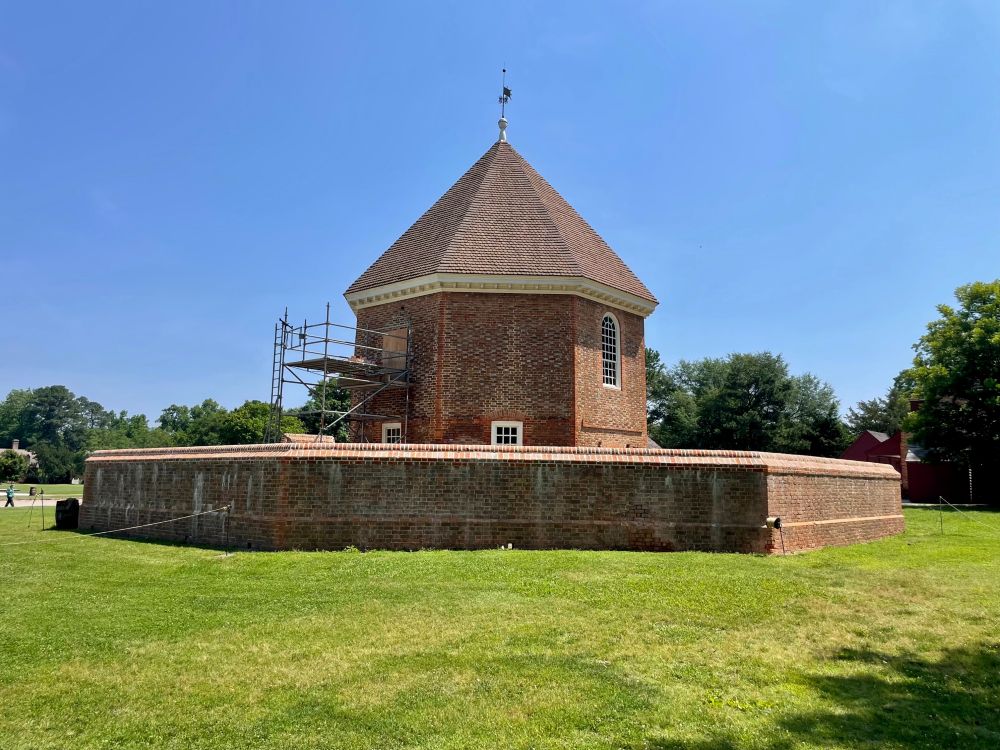
According to Wilkoski, the Grainger Department can now take 3D scans of the building at various renovation stages to “basically digitally peel back layers.”
The department is also applying dendrochronology, or the study of tree rings to estimate wood age, climate data analysis and advanced paint analysis.
Recent changes in building color schemes have had a profound impact on how Colonial Williamsburg looks today.
“That [paint analysis] really revolutionized how the town looks,” Wilkoski said. “If you were visiting Colonial Williamsburg 15 to 20 years ago, it would look very different.”
The 1930s restoration team left minimal documentation regarding their process, which complicated the current work. This time around, Wilkoski is prioritizing leaving behind detailed records for future researchers.
“We’ve been really, really diligent with documenting our process,” Wilkoski said. “So part of that is measuring and drawing and photographing”
Colonial Williamsburg has been at the forefront of historic building restoration for almost a century by continuously refining its methods to reflect the latest research and tirelessly documenting its work.
“I think you could say Colonial Williamsburg has been a pioneer in restoring buildings,” Wilkoski said. “We’ve been doing this for almost 100 years.”
In terms of restoration, the Colonial Williamsburg Foundation is currently the busiest it has been since the 1950s in anticipation of the 250th anniversary.
According to Jack Gary, Associate Vice President of Historic Resources, the site’s original buildings are vital to providing tangible links between visitors and the events that shaped America.
“Learning about pivotal chapters of our nation’s original story in the exact place where history happened gives people the opportunity to not only learn history, but to live it,” Gary said. “Preserving and interpreting these irreplaceable resources is key to fulfilling Colonial Williamsburg’s mission: ‘That the future may learn from the past.'”
For more information on the Magazine’s renovation, visit the Colonial Williamsburg Powder Magazine website.
Thanks for reading! Will you help make our journalism possible?
The Triangle is a uniquely independent news source for Virginia's Historic Triangle and the surrounding region. We need our community's support to keep producing quality local journalism.